Designing Small Backyard Entertainment Spaces: 2026 Guide
Table of Contents
- Start With a Plan: Zoning and Flow for Small Backyard Entertainment Spaces
- Small Backyard Furniture Layout Ideas That Actually Fit
- Small Backyard Lighting Ideas for Evenings Outside
- Outdoor Fire Features for Small Spaces: Heat Without the Footprint
- Shade Structures, Privacy Screening, and Vertical Space
- Climate-Specific Design: What Works Where You Live
- Budget-Friendly Modularity: Building the Space in Phases
- Maintenance Requirements: Choosing Materials That Age Well
- Frequently Asked Questions
Last Updated: September 19, 2026
Start With a Plan: Zoning and Flow for Small Backyard Entertainment Spaces
Designing small backyard entertainment spaces starts with zoning, not shopping. Before you buy a single chair, divide the yard into distinct zones for cooking, dining, conversation, and quiet, then protect clear walking paths between them. At Patio Guild, we've watched homeowners waste both money and square footage by buying furniture first and figuring out layout second.
The payoff is real. A yard that flows feels twice as large as one that doesn't, even when the measured footprint is identical.
Map Your Zones Before You Buy Anything
A zone is a dedicated area with one job: eating, talking, warming up by a fire feature, or growing something. In a compact yard, three zones is usually the ceiling. Four is possible only if you double up, like a fire pit table that becomes a dining surface when covered.

Sketch your space on graph paper, mark the doors and the sun's path, and assign each zone a footprint in square feet. That sketch becomes your shopping list.
Keep 36 Inches of Circulation Space
The single most common mistake is crowding furniture until nothing moves. Standard guidance from landscape design resources on residential circulation points to roughly 36 inches as the minimum comfortable walking width between seating groups, and 18 inches between a sofa and a coffee table.
Below that, guests turn sideways to pass. Nobody lingers in a room they have to navigate like an obstacle course.
Small Backyard Furniture Layout Ideas That Actually Fit
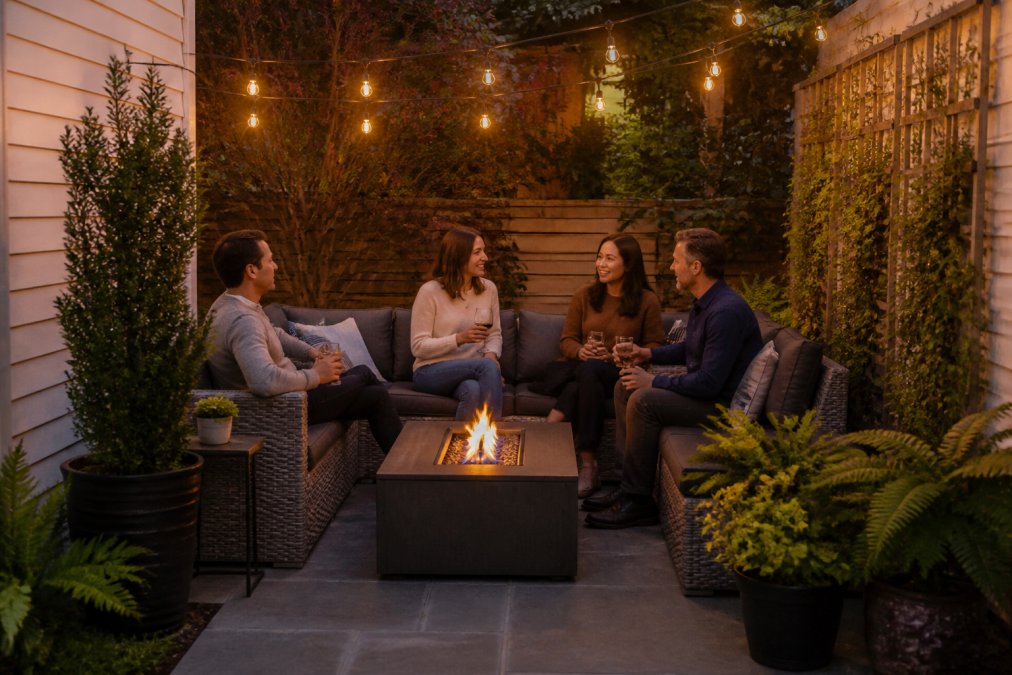
The best small backyard furniture layout ideas follow one rule: fewer pieces, arranged in a conversation circle, with every seat reachable without climbing over anyone. An L-shaped or U-shaped arrangement around a central focal point consistently outperforms rows of furniture pushed against walls.
Modular Sets Beat Fixed Sets in Compact Yards
Modular seating wins because it adapts. A sectional that separates into individual chairs can shift from a party layout to a quiet morning layout in five minutes.
The Gray Wicker 9-Piece Conversation Set w/ Swivel Chairs is a good example of this principle in practice. It seats up to seven, the two swivel chairs rotate a full 360 degrees so guests can follow the conversation or the sunset, and the modular sofa and chair pieces reconfigure to match whatever space you're working with. The steel frame and weather-resistant polyester wicker are built to hold shape and color season after season.

Multi-Functional Pieces Earn Their Footprint
In a small yard, every piece has to justify the square footage it occupies. A storage ottoman doubles as a side table. A fire pit table becomes a coffee table or dining surface when covered.
One honest limitation: multi-functional pieces rarely do any single job as well as a dedicated one. A fire pit table is a decent dining surface, not a great one. Accept the trade-off, or accept the space cost.
Small Backyard Lighting Ideas for Evenings Outside
The best small backyard lighting ideas layer three types: ambient light for overall glow, task light for stairs and food surfaces, and accent light for plants or a focal point. String lights handle ambient duty, path lights handle safety, and uplights aimed at a tree or wall handle drama.
Warm white bulbs in the 2700K range keep the mood cozy; cooler temperatures read as clinical. Run everything on timers or smart plugs so the space turns itself on before your guests arrive.
For a deeper look at layered lighting design, review guidance on outdoor lighting design, which covers efficiency and placement basics for residential exteriors.
Outdoor Fire Features for Small Spaces: Heat Without the Footprint
Outdoor fire features for small spaces work best when they double as furniture. A fire pit table anchors the seating arrangement, provides heat after sunset, and gives the eye a focal point, all in one footprint.

| Option | Best For | Footprint | Key Trade-Off |
|---|---|---|---|
| Round fire bowl | Wrapping seating 360° | Large | Needs open space on all sides |
| Fire pit table | Dual-purpose heat and surface | Medium | Smaller flame than a bowl |
| Fire pit conversation set | All-in-one gathering zone | Largest | Least flexible to rearrange |
The Fog Concrete 42" Round Fire Pit, 60,000 BTU is rated to warm up to 900 square feet with adjustable flame height, and its round shape means no seat has a bad view. If you want heat and seating solved together, the 5-Piece Outdoor Patio Fire Pit Conversation Set pairs four cushioned armchairs with an integrated fire pit table in rust-resistant aluminum.
Shade Structures, Privacy Screening, and Vertical Space
When ground space runs out, build upward. Shade, privacy, and vertical greening all solve the same problem, a small yard with no room to spread out, so treat them as one system rather than three separate purchases.
Match the Shade Structure to the Sun and the Footprint
Shade structures differ less in style than in how much floor they consume and how much sky they block.
| Structure | Floor Footprint | Coverage Pattern | Best For |
|---|---|---|---|
| Cantilever umbrella | Base only, offset arm | Adjustable, movable | Renters and rearrangers |
| Market umbrella | Center pole through table | Fixed circle | Dining tables |
| Retractable awning | None (wall-mounted) | Attached to the house wall | Patios against the home |
| Freestanding pergola | Four posts | Fixed rectangle | Defining a permanent room |
| Wall-mounted pergola | Two posts | Fixed rectangle off the wall | Narrow patios |
A cantilever umbrella is the most flexible option in a compact yard because the base sits to one side and the canopy swings over the seating. The trade-off is stability: cantilever bases need to be weighted, and a gust can tip a lightly ballasted one. A freestanding pergola gives you the most architectural definition, but its four posts eat floor space and it blocks a fixed rectangle of sky whether you want shade that day or not.
Gray Wicker 9-Piece Conversation Set w →
For sun angles, the practical rule is to shade the west and southwest exposure first. Afternoon sun is lower and hotter than midday sun, so a structure on the west side does more work than one directly overhead. In warm climates, a louvered or slatted roof lets heat escape while still cutting direct sun; a solid roof traps it.
Privacy Screening Without a Construction Project
Privacy in a small yard is usually a sightline problem, not a fence problem. Before buying anything, stand at your seating and note exactly where the neighbor's window, deck, or second story looks in. Screen those angles, not the whole perimeter.
- Freestanding screen panels, powder-coated metal or wood frames with weather-resistant fabric or slats. They move, so you can reposition them as sightlines change.
- Retractable privacy screens, roll up when you want openness and pull down when you don't.
- Tall container plantings, a row of tall grasses or columnar evergreens in containers creates a living screen at eye level and can be moved with the seasons.
- Trellis panels with climbing plants, the panel provides the structure, the plant provides the density.
One honest limitation: fabric and slat screens block sightlines but do very little for sound. If noise is the issue, density is what matters, a solid panel, a dense hedge, or a stacked planter wall absorbs and deflects more than an open lattice.
Vertical Space Is the Cheapest Square Footage You Own
Walls, fence lines, and overhead beams are usable area that most small yards leave empty.
- Wall-mounted planters add greenery at eye level without consuming floor.
- Overhead beams give string lights and hanging planters somewhere to attach.
- Tall container plantings define zone edges without building anything permanent.
- Corner shelving or a vertical herb rack turns dead corners into working space.
These moves add enclosure, and enclosure is what makes an outdoor area read as a room rather than a patch of ground. The key is to keep vertical elements at the edges and corners so the center stays open for circulation.
Climate-Specific Design: What Works Where You Live
Most backyard guides assume one climate and one set of materials. That's why so many outdoor setups look perfect in a photograph and fall apart in the yard. Climate drives three decisions: what your furniture is made of, what you plant, and how you handle sun, moisture, and temperature swings. This is the part generic idea lists skip.
Match Materials to Your Weather Pattern
| Climate Pattern | What Fails | What Holds Up |
|---|---|---|
| Humid and rainy | Bare steel frames, untreated wood, standard foam cushions | Powder-coated aluminum, synthetic wicker, quick-dry foam |
| Arid and high-UV | Fade-prone fabrics, low-density resin, dark surfaces that absorb heat | Solution-dyed fabrics, fade-resistant finishes, light-colored surfaces |
| Coastal and salt air | Any ferrous metal, standard hardware, unprotected finishes | Rust-resistant aluminum, stainless hardware, marine-grade fasteners |
| Cold winters with freeze-thaw | Water features, thin ceramics, cushions left out | Weatherproof storage, freeze-tolerant containers, removable textiles |
| Hot and dry with intense sun | Solid-roof structures that trap heat, dark paving | Slatted or louvered shade, light paving, evaporative-friendly planting |
Solution-dyed fabric is the key spec in high-UV climates: the pigment runs through the fiber rather than sitting on the surface, so it resists fading far longer than piece-dyed fabric. In humid climates, the enemy is trapped moisture, quick-dry foam and open-weave wicker let cushions and frames breathe instead of holding damp. In coastal air, salt accelerates corrosion on any ferrous metal, so rust-resistant frames and stainless hardware are the baseline, not an upgrade.
Design Moves That Follow the Climate
- Hot, dry climates: Shade the west exposure, use light-colored paving to reduce heat retention, group plants that tolerate reflected heat, and favor slatted shade over solid roofs so hot air escapes.
- Humid climates: Elevate furniture slightly off the ground, choose open-weave or sling seating, avoid deep foam cushions, and plan for drainage so water doesn't pool under seating.
- Cold climates: Favor furniture you can move or cover, choose containers rated for freeze-thaw, and skip water features that can't be drained and winterized.
- Coastal climates: Rinse frames and hardware periodically to remove salt, choose rust-resistant materials from the start, and accept that even good finishes need more attention near the water.
- Four-season climates: Design for the shoulder seasons, not just the peak. A fire feature extends usable evenings into spring and fall, which is often more valuable than a bigger seating set.
Plant Selection Follows the Same Logic
Plant choice is a climate decision as much as a design one. Drought-tolerant plants suit arid yards and reduce watering; moisture-loving plants suit humid yards but need drainage; cold-hardy perennials suit freeze-thaw regions; and salt-tolerant species are the only reliable choice near the coast. In every climate, containers give you a hedge, you can move them, swap them seasonally, and protect them when the weather turns.
The through-line is simple: match your furniture and plants to your weather, not to a photograph. A set that looks perfect online can be the wrong specification for your zip code, and the cost of getting it wrong shows up as fading, rust, and mildew within a season or two.
Budget-Friendly Modularity: Building the Space in Phases
You don't have to furnish the entire yard in one purchase. Phasing is the most reliable way to build a quality space without blowing the renovation budget.
- Phase 1: Anchor piece (seating set or fire feature)
- Phase 2: Lighting and shade structure
- Phase 3: Softscaping, containers, and textiles
- Phase 4: Accent pieces and upgrades
Buying one durable, weather-tested anchor beats buying four cheap pieces that fade and rust within a season or two. That's the honest case for spending more up front: replacement cost is the hidden expense of bargain outdoor furniture.
Maintenance Requirements: Choosing Materials That Age Well
Low-maintenance materials save you weekends, and they're worth prioritizing in a small yard where every element is visible. Powder-coated aluminum frames, synthetic wicker, and fade-resistant concrete hold up with minimal effort.
- Wipe glass tabletops and hard surfaces monthly during the season
- Rinse wicker and frames seasonally to remove pollen and dust
- Cover fire features and cushions when not in use
- Store textiles in a dry bin through the off-season
The Dark Gray 43.3 In. Fire Pit Table with Glass Wind Guard illustrates the principle: an all-weather PE wicker surround and rust-proof steel frame mean it can stay outside through the season, and the included cover converts it to a dining or coffee table between uses.
Designing a small backyard entertainment space is a planning problem before it's a shopping problem, and the homeowners who get it right are the ones who measure, zone, and phase. Patio Guild builds weather-tested furniture, fire features, and shade structures specifically for compact yards, with modular pieces that reconfigure as your needs change and materials that hold their finish season after season. As an independently owned and operated business, we design for the gathering, not the showroom. Shop Patio Guild and turn your overlooked backyard into the room everyone gravitates toward.
Frequently Asked Questions
What furniture layouts work best for small backyard entertaining?
L-shaped and U-shaped arrangements make the most of a small backyard. Pull seating away from walls and fences so guests can walk behind chairs, and keep 36 inches of clear circulation space around the main gathering area. Modular pieces let you reconfigure the layout for parties versus quiet evenings, and swivel chairs add flexibility without extra footprint. A set like the Gray Wicker 9-Piece Conversation Set w/ Swivel Chairs seats up to seven while staying rearrangeable.
How can lighting enhance a small backyard entertainment area?
Layered lighting makes a compact yard feel larger and keeps guests outside after sunset. Combine overhead string lights for ambient glow, low path lights for safety, and a small table lamp or candle lantern for warmth at eye level. Battery and solar options avoid running new wiring. Aim for three light layers, and put everything on timers so the space turns on before your first guest arrives.
What are the best ways to create privacy in a small backyard?
Vertical space is your best tool in a compact yard. Tall planters with evergreens, freestanding privacy screens, and outdoor curtains block sightlines without eating floor area. A pergola with a retractable awning or climbing vines softens the boundary and adds shade at the same time. Combine two or three of these so the yard feels enclosed but still gets airflow and light.
Do outdoor fire features for small spaces actually put out enough heat?
Yes, if you match the BTU rating to the area. A 60,000 BTU fire pit like the Fog Concrete 42-Inch Round Fire Pit warms up to 900 square feet, which covers most small yards and even a connected patio. For tighter spaces, a fire pit table converts to a dining or coffee table when not in use, so it earns its footprint year-round. Wind guards help retain heat on breezy evenings.