Best Weather Resistant Patio Furniture Materials for 2026
Table of Contents
- How We Evaluated Weather Resistant Patio Furniture Materials
- The Five Criteria That Separate Real Durability From Marketing Claims
- Quick Comparison: Weather Resistant Patio Furniture Materials at a Glance
- Powder-Coated Aluminum and Stainless Steel: The Metal Frames That Resist Rust
- HDPE Lumber, Synthetic Resin, and All-Weather Wicker: Polymer That Outlasts Wood
- Kiln-Dried Teak, Eucalyptus, and Shorea: Hardwood That Earns Its Price
- Best Outdoor Furniture Fabrics for Sun Protection
- Regional Climate Matching: Coastal, Desert, and Winter Exposure
- Patio Furniture Care Tips That Extend Material Life
- Cost-Per-Year Analysis: Why Cheap Furniture Costs More
- Frequently Asked Questions
Last Updated: September 11, 2026
How We Evaluated Weather Resistant Patio Furniture Materials
The best weather resistant patio furniture materials are powder-coated aluminum, HDPE lumber, and kiln-dried teak, each earning its place through a different combination of corrosion resistance, structural strength, and cost longevity. We evaluate every material against five criteria: rust and corrosion resistance, UV fade resistance, structural integrity under load, moisture and mildew behavior, and repairability when something finally does go wrong.

That last criterion is the one most buyers ignore, and it's the one that separates a ten-year investment from a three-year mistake.
This guide breaks down how each material family actually performs, where the marketing claims fall apart, and which option matches your specific climate.
The Five Criteria That Separate Real Durability From Marketing Claims
Every material claim you read online reduces to five measurable properties. Rust resistance determines whether a frame survives coastal humidity. UV resistance decides whether color holds after two summers. Structural integrity covers weight capacity and wind load. Moisture behavior predicts mildew and rot. Repairability determines whether a scratch becomes a permanent flaw or a weekend fix.
Material |
Rust Resistance |
UV Fade Resistance |
Repairability |
Typical Lifespan |
|---|---|---|---|---|
Powder-coated aluminum |
Excellent |
Excellent |
Moderate |
15-20 years |
Stainless steel |
Excellent |
Excellent |
Moderate |
20+ years |
HDPE lumber |
N/A (no metal) |
Excellent |
High |
20+ years |
PE rattan over steel |
Good |
Good |
Low |
8-12 years |
Kiln-dried teak |
N/A (no metal) |
Excellent |
High |
15-25 years |
Eucalyptus / shorea |
N/A (no metal) |
Good |
High |
8-15 years |
Quick Comparison: Weather Resistant Patio Furniture Materials at a Glance
Weather resistant patio furniture materials split into three families, and each one wins in a different climate and budget bracket. Metal frames resist rust and hold structural shape. Polymer materials resist moisture entirely. Hardwoods resist both but demand periodic oiling.
Here's the short version before we go deep:
- Powder-coated aluminum: best all-around for humid and coastal climates
- HDPE lumber: best for salt air and full-sun exposure
- Kiln-dried teak: best for buyers who want natural grain and will maintain it
- PE rattan over steel: best budget option, shortest lifespan
- Stainless steel: best for structural pieces like bar stools and frames
The trade-off between weather resistance and aesthetics is real. Polymer and metal hold color and shape with almost no input. Wood looks better than both, but only if you commit to annual care.

Powder-Coated Aluminum and Stainless Steel: The Metal Frames That Resist Rust
Powder-coated aluminum is the best metal choice for weather resistant patio furniture because the coating forms a bonded shell that resists corrosion, chipping, and UV fade far better than paint. Stainless steel outperforms aluminum on raw tensile strength, but it costs more and weighs considerably more per piece.
Aluminum's advantage is the oxide layer that forms naturally on its surface. That layer blocks further corrosion even when the powder coat gets scratched. Steel has no such defense. Once moisture reaches bare steel, rust spreads under the surrounding coating and lifts it from underneath.
Where stainless steel earns its premium: bar stools, structural supports, and any piece bearing heavy repeated load. The ASTM International standards for metallic-coated steel give a useful reference for how coatings are graded, which helps you read spec sheets without guessing.
Where Aluminum Wins and Where It Dents
Aluminum wins on weight, corrosion resistance, and price. A powder-coated aluminum frame typically weighs roughly half what an equivalent steel frame does, which matters if you rearrange your patio seasonally or move furniture before storms.
The honest limitation is dent resistance. Aluminum is softer than steel, so a dropped umbrella base or a stray impact can leave a dent that steel would shrug off. For seating and dining frames, that's rarely an issue. For anything that takes direct abuse, stainless steel is the safer pick.
HDPE Lumber, Synthetic Resin, and All-Weather Wicker: Polymer That Outlasts Wood
High-density polyethylene lumber is the most weather-resistant material available for outdoor furniture, because it contains no cells to absorb water and no metal to corrode. HDPE is a dense plastic lumber made from recycled material that holds color and shape through freeze-thaw cycles, salt spray, and full sun.
Synthetic resin and marine-grade polymer behave similarly. They don't rot, they don't host mildew on the material itself, and they never need sealing. All-weather wicker, usually woven PE rattan over a metal frame, gets most of the same benefits, though the frame underneath is the weak point.
What most guides miss is that polymer's weakness isn't weather at all. It's heat. Dark-colored HDPE in direct desert sun can soften and warp under sustained load, so a dark polymer bench left in full afternoon sun may bow over time. Lighter colors and shaded placements avoid this entirely.
Where polymer falls short on aesthetics, it wins on upkeep. A rinse with a hose handles almost everything.
Kiln-Dried Teak, Eucalyptus, and Shorea: Hardwood That Earns Its Price
Kiln-dried teak is the hardwood benchmark for outdoor furniture because its natural oils and dense grain resist moisture, insects, and rot without chemical treatment. Eucalyptus hardwood and shorea wood offer much of the same performance at lower cost, though both demand more frequent oiling to hold up.
The kiln-drying process matters more than most buyers realize. Wood dried too quickly develops internal stresses that cause checking and splitting within a season. Properly kiln-dried stock stabilizes at a moisture content that lets it move with humidity changes instead of cracking against them.
Teak's famous patina is a feature, not a defect. Left untreated, the honey-gold color fades to a soft silver-gray. Some buyers want that. Others oil annually to keep the original tone. Either approach preserves the wood. Skipping both is what causes problems.
Eucalyptus and shorea sit a tier below teak on oil content, which is why they cost less and need more attention.
Why Mortise and Tenon Joinery Matters More Than Species Alone
Mortise and tenon joinery matters more than species because a well-joined eucalyptus piece outlasts a poorly joined teak one every time. This traditional joint cuts a projecting tenon into one piece that seats into a matching mortise in another, creating mechanical strength rather than relying on screws or glue alone.
Screws loosen as wood expands and contracts through seasons. A mortise and tenon joint moves with the wood and holds its geometry. When you're comparing hardwood sets, look at the joints before you look at the label. A premium species assembled with pocket screws is a downgrade hiding behind a good name.
Best Outdoor Furniture Fabrics for Sun Protection
The best outdoor furniture fabrics for sun protection are solution-dyed acrylics, which hold color against UV exposure far longer than piece-dyed or polyester alternatives. Solution dyeing pushes pigment into the fiber before it's spun, so fading happens at the surface rather than through the whole thread.
Fade-resistant outdoor fabric also needs mildew resistance and moisture-wicking behavior. Cushions that trap water grow mildew from the inside, and no amount of surface cleaning fixes that. Look for covers with breathable backing and quick-dry foam cores.
What most shoppers don't check: whether the fabric carries a PFAS-free claim. Per- and polyfluoroalkyl substances have been used as stain and water repellents in some outdoor textiles, and the EPA information on PFAS explains why regulators and manufacturers have been moving away from them. If chemical safety matters to you, ask the manufacturer directly rather than assuming.
Fabric Type |
UV Fade Resistance |
Mildew Resistance |
Best For |
|---|---|---|---|
Solution-dyed acrylic |
Excellent |
Good |
Full-sun exposure |
Olefin |
Good |
Excellent |
Humid climates |
Polyester |
Moderate |
Moderate |
Covered patios |
Acrylic-coated |
Good |
Good |
Mixed sun and shade |
Regional Climate Matching: Coastal, Desert, and Winter Exposure
Climate matching is the single most useful filter when choosing weather resistant patio furniture, because the material that wins in coastal salt air is not the material that wins in desert sun. Coastal living punishes metal. Desert exposure punishes dark polymer and untreated wood. Winter exposure punishes anything that traps water.
Salt Air, Humidity, and What Actually Corrodes
Salt air accelerates corrosion on any ferrous metal, which is why wrought iron and standard steel fail fastest near the coast. Even powder-coated steel eventually loses the fight at scratch points and weld seams. Aluminum, stainless steel, and HDPE lumber are the coastal-safe choices.
Humidity adds a second problem: mildew. Non-porous materials like polymer and powder-coated metal don't host it. Wood and woven fabrics can, unless they're treated and allowed to dry fully between rains.
For freeze-thaw regions, water is the enemy. Any hollow frame that traps moisture can crack when it freezes and expands. Look for frames with drainage paths or sealed construction.
Patio Furniture Care Tips That Extend Material Life
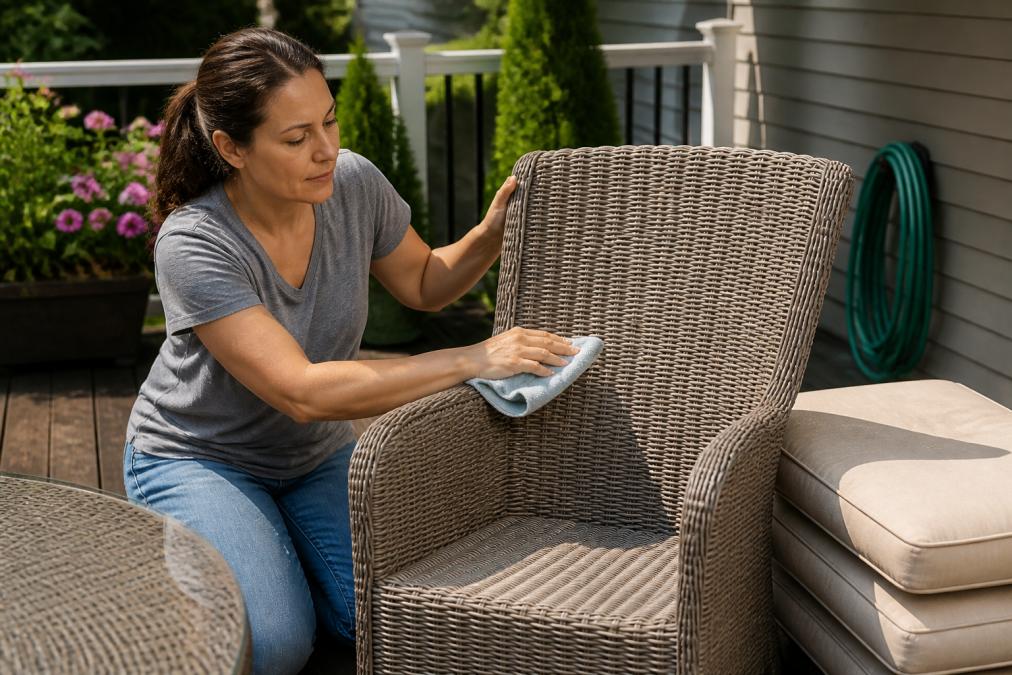
Patio furniture care tips that actually extend life come down to four habits: rinse salt and pollen regularly, dry cushions fully before storing, oil hardwood on schedule, and touch up coating damage before rust starts. None of these take long, but skipping them shortens lifespan noticeably. What most guides leave out is the repair side of care, the specific fixes that turn a scratch, a chip, or a grayed board back into a piece that looks new.
Repairing Powder-Coat Chips Before Rust Starts
A powder-coated aluminum frame fails at the chip, not the panel. Once the coating breaks, usually at a weld seam, a bolt hole, or a spot where a chair leg drags across concrete, the exposed aluminum forms its own oxide layer and resists further corrosion on its own. That's the aluminum advantage. But the chip still looks bad and it still collects dirt, so the fix is worth doing.
A common pattern is a two-step touch-up: clean the chip with denatured alcohol, then apply a matching touch-up paint or a small brush-on enamel in thin coats rather than one thick blob. Thin coats bond better and dry without a ridge. Let each coat cure fully before the next. For steel frames, the timeline is tighter, bare steel starts rusting within days in humid air, so touch up within a week of spotting the damage.
Re-Oiling Hardwood Without Overdoing It
Teak and eucalyptus don't need oil to survive. They need it to hold their original honey tone instead of weathering to silver-gray. The mistake most people make is oiling too often. A heavy annual coat on already-saturated wood traps moisture against the grain and can feed surface mildew.
A better rhythm: clean the surface with a soft brush and mild soap, let it dry for a full day, then apply a thin coat of a penetrating hardwood oil and wipe off the excess within 30 minutes. If the wood still looks wet after wiping, you used too much. Once a year is enough in most climates; twice a year only if the piece sits in full sun and you want to preserve the original color.
Cushion Care That Prevents Mildew From the Inside
Water-resistant outdoor fabric still needs to dry completely. Stacking damp cushions at the end of a party traps moisture against the fabric and foam, which is how mildew starts, and once mildew is inside the foam core, no amount of surface cleaning fixes it. Stand cushions upright on edge after rain or use so air moves through both faces.
For deeper cleaning, a diluted mild soap and water solution with a soft brush handles most stains. Skip bleach on solution-dyed acrylics, it dulls the pigment even though the fiber itself holds color. If a cushion cover is removable and machine washable, follow the manufacturer's tag rather than guessing.
A Simple Seasonal Checklist
- Rinse metal and polymer frames monthly during pollen season
- Touch up any coating chip within a week of spotting it
- Clean and oil hardwood once a year, thin coat only
- Stand cushions upright to dry after rain or use
- Store or cover fabric items through winter
Cost-Per-Year Analysis: Why Cheap Furniture Costs More
Cost-per-year analysis reveals that the cheapest patio furniture is almost always the most expensive, because replacement cycles erase the upfront savings. A budget set that lasts three seasons before rust and fade make it unusable costs more per year than a premium set that runs fifteen. The math is simple, but almost no guide actually runs it.
How to Run the Calculation Yourself
Divide the purchase price by the expected years of service. That single number reframes the whole decision. A set that costs twice as much but lasts three times as long wins on cost-per-year every time, and it wins by a wider margin than most buyers expect, because the cheap set also carries hidden costs: replacement cushions, touch-up paint, and the time spent shopping again.
A useful way to think about it: the material with the longest service life isn't always the winner. What matters is service life divided by the effort and money required to keep it there. A hardwood set that needs annual oiling and occasional joint tightening may cost more per year in labor than an HDPE set that needs a rinse. That's a real trade-off, and it's the one most comparisons skip.
Where Repairability Changes the Math
Repairability is the variable that quietly extends service life. A powder-coated aluminum frame with a chip you can touch up in ten minutes adds years to the piece. A mortise-and-tenon hardwood joint that can be re-glued and re-tightened outlasts a screwed joint that strips out after two seasons of expansion and contraction. A woven PE rattan chair with a replaceable cushion cover survives a fabric failure that would otherwise retire the whole chair.
Materials that can't be repaired, or that hide their failure points, tend to fail all at once. That's the pattern behind most 'it looked fine and then it didn't' reviews. When you're comparing sets, ask two questions: what's the first thing likely to fail, and can I fix it myself?
The Sustainability Angle
Longer service life is also the most credible sustainability claim in outdoor furniture. HDPE lumber made from recycled material is a genuine example, it diverts plastic from the waste stream and it lasts decades, so the environmental benefit compounds. The FTC guidance on environmental marketing claims is worth reading if sustainability factors into your decision, since it explains what 'eco-friendly' and 'recycled' claims actually have to substantiate.
We build around weather-tested materials for exactly this reason. Our 5-Piece Outdoor Patio Fire Pit Conversation Set with Cushioned Armchairs and Fire Pit Table uses rust-resistant aluminum with weather, UV, and water resistant materials, and our 5-Piece Wicker Patio Furniture Set pairs UV-resistant PE rattan with a rust-proof steel frame. Both are designed to be the last set you buy for a while, not the next one in a replacement cycle.

Frequently Asked Questions
What is the most durable weather-resistant outdoor furniture?
Powder-coated aluminum frames paired with HDPE lumber or high-density polyethylene wicker hold up best across most climates. Aluminum resists rust and corrosion, while HDPE does not absorb moisture, crack, or fade under UV exposure. For coastal settings, marine-grade polymer and stainless steel hardware add another layer of protection against salt air. Kiln-dried teak also performs well if you accept annual oiling to maintain its color and prevent surface checking.
What is the best waterproof material for outdoor furniture?
No material is fully waterproof, but HDPE lumber, synthetic resin, and powder-coated aluminum shed water instead of absorbing it. Cushions matter just as much: look for solution-dyed acrylic or olefin covers with moisture-wicking cores, because standard foam soaks up rain and grows mildew. Quick-dry reticulated foam drains in minutes, which keeps cushions usable after a storm.
Can teak furniture be left outside all year long?
Yes. Kiln-dried teak contains natural oils that resist rot, insects, and moisture, so it can stay outdoors through winter in most regions. It will weather to a silver-gray patina unless you oil it annually. In areas with heavy snow, cover the furniture or move it to a sheltered spot to prevent ice from stressing mortise and tenon joints. Eucalyptus and shorea wood behave similarly but need more frequent oiling.
What are the pros and cons of aluminum vs. resin wicker for outdoor use?
Aluminum is lighter, stronger, and resists rust, which makes it easy to rearrange and long-lasting. It can dent under heavy impact and gets hot in direct sun. Resin wicker, usually all-weather wicker wrapped around a metal frame, offers more texture and hides scratches well. It may fade or crack after years of UV exposure, and the weave can trap dirt. Both need periodic cleaning with mild soap and water.
How do I choose patio furniture that withstands high humidity and salt air?
Prioritize corrosion-resistant frames such as powder-coated aluminum or marine-grade polymer, and avoid untreated steel and wrought iron. Stainless steel hardware matters because salt air attacks hinges, bolts, and welds first. Rinse frames monthly with fresh water to remove salt residue, and choose fade-resistant outdoor fabric rated for UV exposure. In humid climates, store cushions indoors between gatherings to prevent mildew growth.